The Correction Is the Artifact
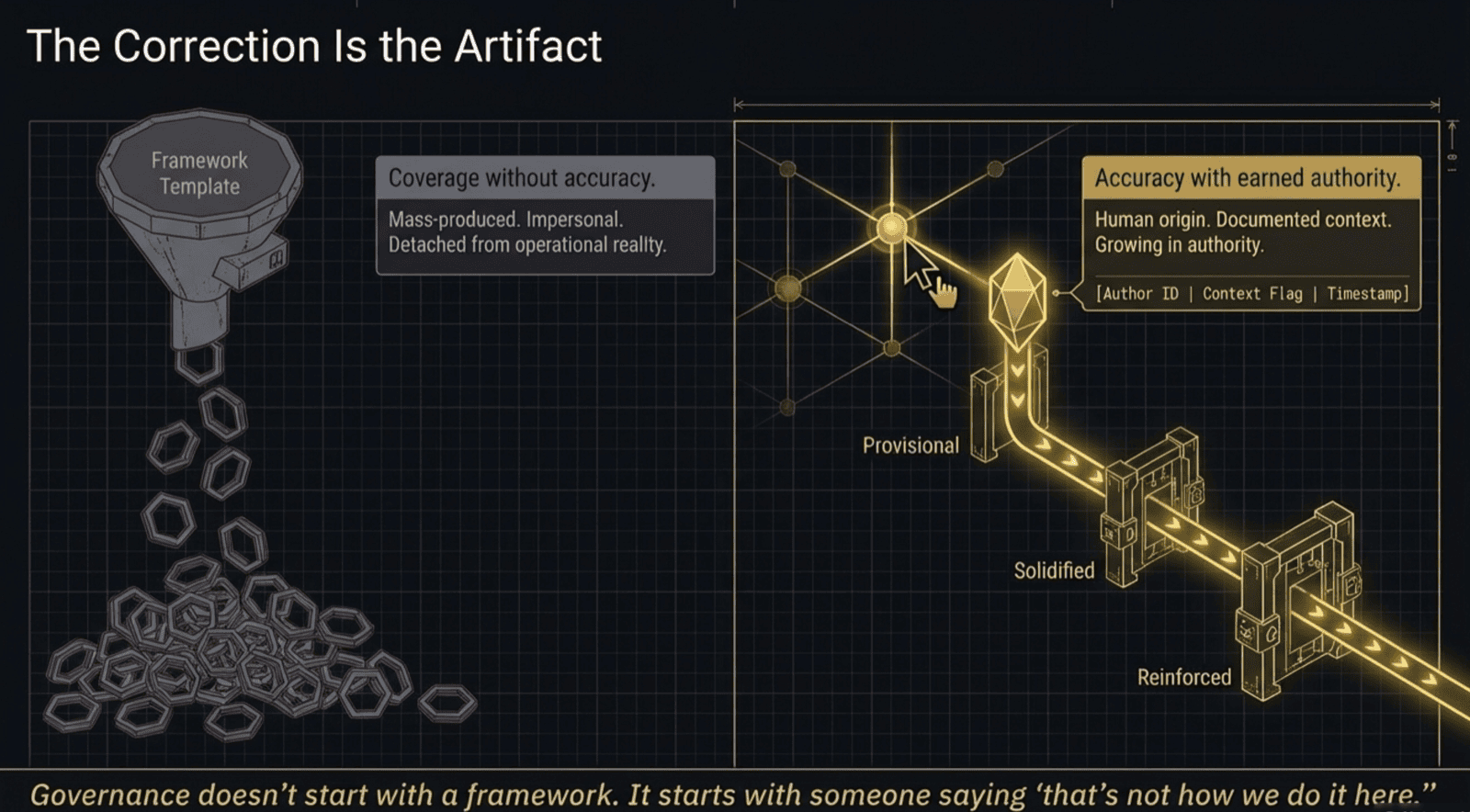
Most governance starts with a template.
Someone selects a compliance framework — SOC 2, HIPAA, ISO 27001 — and the tooling generates a set of controls mapped to that framework. The controls become policy documents. The policy documents get stored in a wiki. A quarterly review cadence is established. Evidence collection is automated. The organization is now "governed."
Except nothing about that process originated from the organization itself.
The controls came from the framework. The policy language came from the template. The structure came from the vendor. The only organizational input was selecting which framework to adopt and assigning ownership to named individuals. The resulting policies describe what the framework requires, not what the organization has actually learned about how it operates.
This is the template problem. And it explains why most compliance policies are simultaneously comprehensive and useless — they cover every control and reflect no actual operational knowledge.
Where Governance Actually Originates
Governance does not start with a framework. It starts with someone saying "that's not how we do it here."
A senior engineer reviews a pull request and corrects an API pattern that violates the organization's architectural standards. A compliance lead identifies that a data processing workflow routes personally identifiable information through a system that isn't cleared for PII. A manager observes that a team's incident response deviated from the established escalation protocol.
Each of these moments contains a governance signal. Something was done incorrectly. Someone with domain knowledge identified the deviation. The correct behavior was articulated.
In the current compliance stack, these corrections disappear. The pull request comment gets buried. The compliance escalation gets resolved as a one-time fix. The manager's feedback exists only in the memory of the people who were in the room. None of it feeds back into the policy layer. None of it becomes a governance artifact.
The correction — the actual moment when organizational knowledge was applied to identify and resolve a deviation — is the most valuable governance signal an organization produces. And no existing compliance tool captures it.
Corrections Are Not Tickets
The instinct when hearing "capture corrections" is to think of ticketing systems. A deviation is identified, a ticket is opened, the ticket is resolved, the ticket is closed. The correction is documented in the ticket history.
But a ticket captures the incident. It does not capture the governance artifact.
The governance artifact is not "this thing went wrong and was fixed." It is "this is the correct behavior, and here is the human authority behind it." A ticket records what happened. A correction captured as a governance artifact records what should always happen, who decided it, and how confident the organization should be in that decision.
The difference matters because tickets are retrospective and disposable. They describe a moment. A governance artifact captured from a correction is prospective and persistent. It describes an organizational standard with a documented origin, and it matures into an enforceable rule through subsequent review and confirmation.
From Correction to Constraint
When a correction is captured with attribution — who made it, in what context, what the correct behavior is — it enters the governance layer as a provisional rule. It is not yet enforced. It has a single human origin and has not been reviewed or confirmed beyond the initial correction.
Over time, if the same pattern is corrected again in a different context, or if a human with authority reviews the provisional rule and promotes it, the rule matures. It moves from provisional to solidified — now confirmed across multiple contexts with deliberate human review. Eventually, after sustained stability and full documentation of its decision history, it reaches reinforced status: structurally enforced, with a complete provenance chain.
This maturation process is the opposite of template-driven governance. The template starts with full authority and no organizational grounding. The correction starts with complete organizational grounding and earns its authority through documented human decision-making.
A template gives you coverage. A correction gives you accuracy.
The Organizational Knowledge Problem
Organizations know far more about how they should operate than their policy documents reflect. That knowledge lives in the heads of senior engineers, experienced compliance leads, tenured managers — the people who make corrections every day based on hard-won understanding of how the organization works.
When those people leave, their corrections leave with them. The next person encounters the same deviations and either makes the same corrections (reinventing governance from scratch) or doesn't catch them (allowing drift). There is no institutional memory of what was corrected, by whom, or why.
This is the same problem that governance frameworks attempt to solve with documentation. But documentation created from templates captures the framework's knowledge, not the organization's. Only corrections captured from actual operational experience carry the organization's own understanding of how it should function.
The Real Artifact
Governance doesn't start with a framework. It starts with someone identifying a deviation and correcting it. That correction — captured with attribution, matured through review, and enforced as structural constraint — is the governance artifact.
Raknor captures corrections as governance artifacts with attribution, then matures them into enforceable policy through documented human review. The correction is the origin. The provenance chain is the proof.