The Provenance Chain Is the Audit Artifact
The week before an audit is the most expensive week in compliance.
Evidence is collected from a dozen systems. Screenshots are captured from consoles that may have changed since the last review. Log extracts are pulled and formatted. Policy attestation emails are chased. Control owners are asked to confirm that their controls are still effective — a question most of them answer from memory, not from data.
All of this effort serves a single purpose: proving, after the fact, that governance happened.
Some of the evidence is real and current — organizations running continuous monitoring, daily security posture scans, automated configuration checks are producing genuine operational evidence every day. But the audit-prep process treats that evidence the same way it treats a six-month-old screenshot: as an artifact to be assembled into a package. The monitoring produces findings. The governance process produces corrections. The evidence process runs alongside both, collecting artifacts on a parallel timeline rather than flowing from the governance actions themselves.
The evidence-collection workstream and the governance workstream touch the same controls but produce separate artifacts on separate timelines. That separation is the architecture that produces compliance drift, audit-prep scrambles, and the persistent gap between what policy documents say and what operational systems actually do. And it is fundamentally unnecessary.
Two Systems That Can Drift Apart
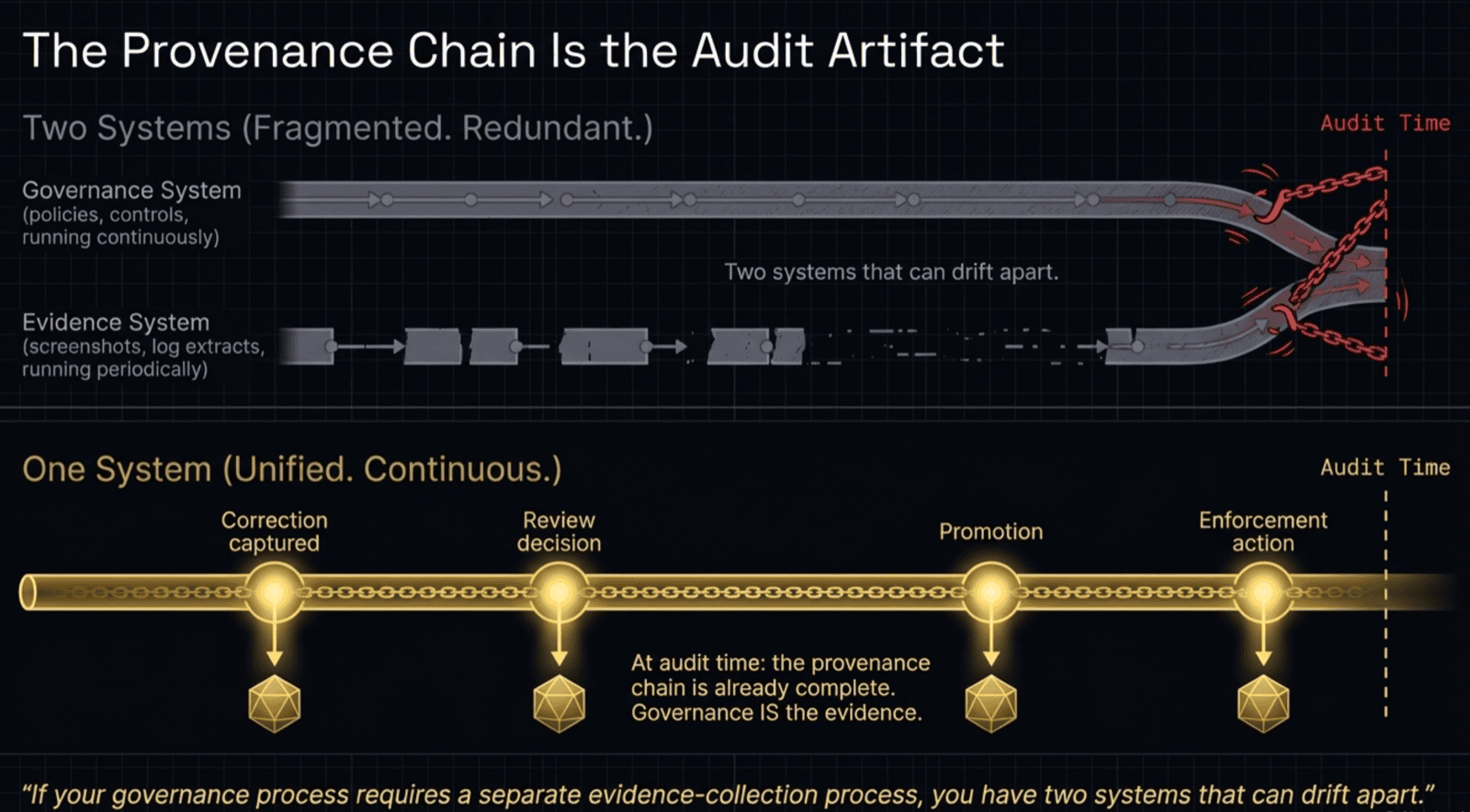
When governance and evidence collection are separate processes, you are maintaining two systems. One system governs. The other system proves that governance happened.
Two systems can drift apart. And they do.
The governance system — whatever combination of policies, controls, and monitoring the organization uses — evolves as the organization changes. New systems are deployed. Processes are updated. Exceptions are granted. Controls are modified or deprecated.
The evidence system — the collection of artifacts, attestations, screenshots, and log extracts that constitute the audit package — reflects the state of governance at the time each piece of evidence was captured. If evidence is collected quarterly, it reflects quarterly snapshots. Between snapshots, the governance system continues to evolve without corresponding evidence updates.
The result is an audit package that is simultaneously accurate and incomplete. Each piece of evidence accurately reflects the state of a control at the time it was captured. But the collection as a whole does not reflect the current state of governance, because evidence collection does not track every governance change in real time.
Auditors know this. Sophisticated audit teams test for currency — they look at when evidence was generated, whether controls have changed since the evidence was captured, and whether the evidence reflects the organization's current operational state. When they find gaps between evidence and reality, the finding is not that governance failed. It is that the evidence of governance is insufficient. Which, from an audit perspective, amounts to the same thing.
Evidence as Byproduct
There is an alternative architecture where evidence is not a separate workstream — where compliance documentation and operational governance stay in sync because they're the same system.
Organizations already doing continuous monitoring are halfway there. A daily Security Hub scan that discovers a misconfiguration, triggers remediation, and documents the closure is producing real evidence as a byproduct of real governance. The scan is operational. The finding is operational. The remediation is operational. The evidence — the finding, the action taken, the closure — is generated by the governance process, not assembled by a parallel evidence-collection process.
The problem is that most organizations have this operational loop running alongside a separate compliance documentation process. The security team remediates findings daily. The compliance team collects evidence quarterly. The two streams touch the same controls but operate on different timelines, in different systems, with different owners. The daily operational evidence exists, but it's not connected to the policy layer that gives it meaning.
When policy operates through a provenance chain — captured from corrections, matured through documented human review, enforced as structural constraints — the operational monitoring, the policy enforcement, and the evidence all flow through one system. A correction is captured: who identified the deviation, when, in what context, and what the correct behavior is. A reviewer promotes the correction to solidified status: who reviewed it, when, what evidence supported the decision. The rule reaches reinforced status and is structurally enforced: every enforcement action documents what was blocked, when, which rule, and the full provenance chain behind the rule. An automated scan discovers a violation: the finding links to the rule, the remediation links to the finding, the closure updates the evidence.
Compliance documentation and live enforcement stay in sync because they're the same process. The policy that defines the correct state, the monitoring that detects deviation from it, the correction that addresses the deviation, and the evidence that documents the closure are one pipeline — not four parallel workstreams that someone reconciles during audit prep.
What the Auditor Sees
An auditor examining a Raknor-governed policy does not see a document with an attestation checkbox.
They see the correction that originated the rule — who made it, when, and what deviation prompted it. They see the review history — who confirmed it, when it was promoted, what evidence supported each promotion decision. They see the enforcement record — every action where the rule was applied, including any exceptions that were granted and the documented reasoning behind each exception.
The provenance chain is not a summary of governance. It is a complete, continuous, machine-readable record of every human decision and system action that constitutes the governance of that specific rule. It is more comprehensive than any evidence package an audit-prep process could produce, because it captures everything — not just the subset that someone remembered to document.
For the auditor, this means control effectiveness testing can focus on evaluating the governance decisions themselves rather than verifying that evidence was collected. The question shifts from "can you prove this control was effective?" to "was the decision-making behind this control sound?" That is a more meaningful audit — and one that produces more valuable findings for the organization.
One System
If your governance process requires a separate evidence-collection process, you have two systems that can drift apart. This is true even when both systems are automated. An automated monitoring tool and an automated evidence collector are still two systems — and two automated systems can drift apart just as effectively as two manual ones.
The structural solution is not faster evidence collection. It is eliminating the separation between governance and evidence. When the monitoring that discovers drift, the policy that defines correct state, the correction that addresses the deviation, and the evidence that documents the closure all flow through one system, there is nothing to reconcile. Compliance documentation stays current because it's generated by the same process that enforces compliance.
The provenance chain is not audit evidence. It is proof that governance is structural, not performative — and that the documentation and the enforcement have never been out of sync, because they were never separate.
Raknor keeps compliance documentation and live policy enforcement in one system. Every correction, review, promotion, enforcement action, and operational finding is documented as it happens — not reconstructed during audit prep.